


Grill Pan Enamel: Cast Iron, Even Heat, Easy-Clean Square
The Real-World Guide to Grill Pan Enamel: Trends, Specs, and What Pros Actually Buy
If you’ve been eyeing Grill Pan Enamel products lately, you’re not alone. The category has exploded—partly because home cooks want the restaurant sear without the smoke, and partly because enamel colors look gorgeous on an open shelf. Here’s the twist: many kitchens are still choosing pre-seasoned cast iron for the performance edge. The “Wholesale Kitchen Cookware Pre-Seasoned Cast Iron Skillet Steak Grill Pan” from Hebei, China (Dongzhangfeng Village, Xushui District, Baoding) is a good example of why.
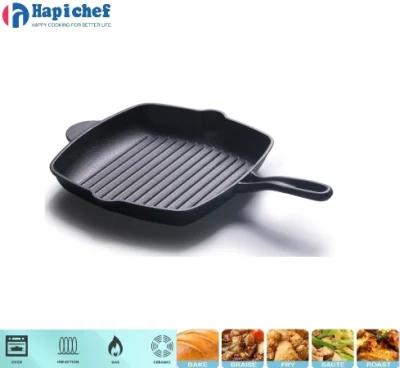
What the market is actually buying
Trends point both ways. Enamel-coated cast iron sells on aesthetics, easy cleaning, and neutral reactivity. Pre-seasoned cast iron wins on peak searing and lifetime durability. In fact, many customers say they start with enamel for the look, then add a heavy, ridged, pre-seasoned skillet for steak night. And yes, I do the same—because grill marks still sell the dish before the first bite.
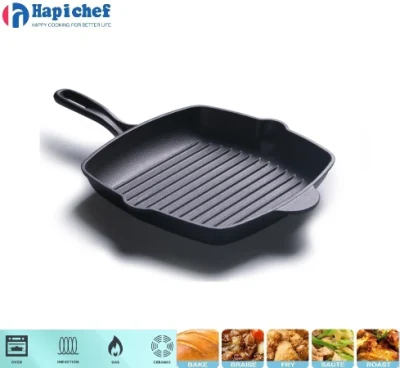
Technical specifications (real kitchen numbers)
| Parameter | Spec (≈, real-world use may vary) |
|---|---|
| Material | High-carbon cast iron (ASTM A48 Class 30–40 equivalent) |
| Finish | Pre-seasoned vegetable-oil film; optional Grill Pan Enamel colorways on request |
| Size/Thickness | 10–12 in; wall 3.5–4.0 mm; ridge height ≈5–6 mm |
| Heat sources | Gas, electric, induction, oven (up to 260–300°C) |
| Heat retention | ΔT drop |
| Compliance | LFGB, FDA 21 CFR food-contact, EU 1935/2004 |
| Origin | Dongzhangfeng Village, Xushui District, Baoding, Hebei, China |
| Service life | Pre-seasoned: decades with care; enamel: 5–15 yrs typical |
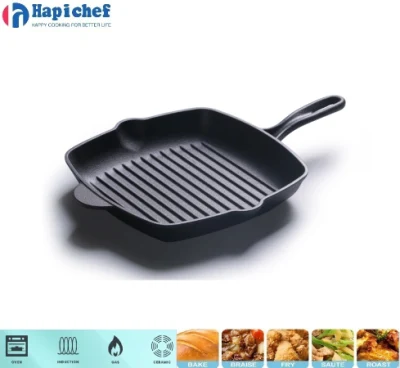
How it’s made (process flow)
Materials: pig iron + steel scrap refined for low impurities; silica sand molds. Methods: sand casting → shot-blast → CNC skim/machine → edge deburr → clean/dry → either pre-season (flax/soy-based oil bake) or apply vitreous enamel ground coat + color coat, fired ≈760–820°C. Testing: enamel adhesion/thermal shock per ISO 4530/ISO 28706; migration per LFGB and FDA; salt-spray (ISO 9227) for hardware; handle torque tests; carton drop tests. To be honest, this is where many budget pans cut corners—temperature uniformity during firing changes chip resistance later.
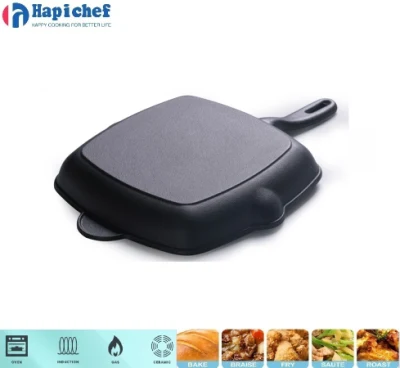
Where it shines
- Steaks, pork chops, halloumi, asparagus—those ridges deliver Maillard and drainage.
- Indoor grilling when outdoor isn’t an option; oven-finishing without fuss.
- Restaurant backup for consistent crosshatch marks on the pass line.
Advantages: fast sear, even heat, minimal warping, and a surface that actually improves with use. With Grill Pan Enamel, you gain color and simpler cleaning; with pre-seasoned you get max browning. Pick your battles.
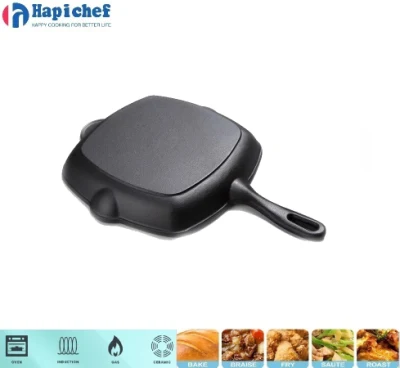
Vendor snapshot (B2B quick compare)
| Vendor | Finish | Certs | MOQ | Lead time | Customization |
|---|---|---|---|---|---|
| Hebei Manufacturer (this model) | Pre-seasoned; optional Grill Pan Enamel | LFGB, FDA, ISO 9001 | ≈500 | 30–45 days | Logo emboss, enamel color, packaging |
| Vendor A (generic) | Enamel only | LFGB | 1000 | 45–60 days | Limited colors |
| Vendor B (generic) | Pre-seasoned | FDA | 800 | 35–50 days | Basic logo only |
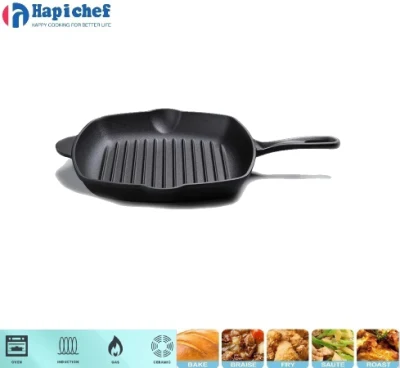
Customization, testing, and field notes
Options include enamel hues (matte black, cherry, ocean), ridge geometry, helper-handle shape, and retail box design. Typical tests passed: thermal shock (no chip at 180°C quench), enamel thickness ≈200–350 μm, LFGB overall migration ≤10 mg/dm², induction efficiency verified on 180 mm coil. One hotel client in Shenzhen replaced flattops with six of these skillets and reported 12–15% faster ticket times for steaks—small sample, but it tracks with higher surface energy on ridges. Another DTC brand ran a limited-edition Grill Pan Enamel teal release and saw a 2.1x conversion uplift versus bare black.
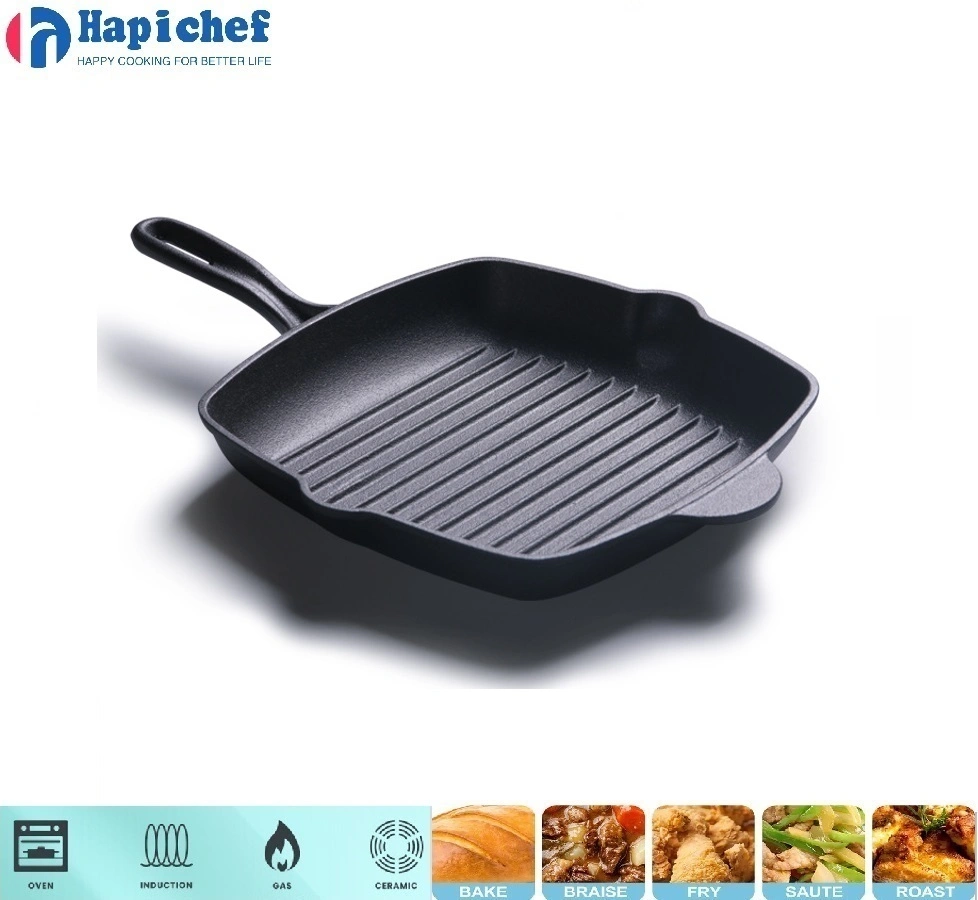
User feedback? “Holds heat like a champ and the seasoning got slick after week two,” says a Guangzhou cafe owner. I guess that’s the quiet secret: performance first, pretty second. Ideally, you get both.
Citations
- EN 12983-1: Cookware for domestic use—General requirements.
- ISO 28706 & ISO 4530: Vitreous and porcelain enamels—Corrosion and thermal shock tests.
- LFGB (Germany) Food and Feed Code—Food-contact migration limits.
- FDA 21 CFR 175.300: Resinous and polymeric coatings for food contact.
- EU Regulation No 1935/2004: Materials intended to come into contact with food.
- ASTM A48: Gray iron castings—classifications used in cookware-grade iron.
-
How to Choose and Maintain the Perfect Frying Pan for CookingNewsApr.16,2026
-
Mastering the Art of Cooking with a Dutch Oven GuideNewsApr.09,2026
-
Exploring the World of Casseroles A Kitchen Essential for Flavorful MealsNewsApr.07,2026
-
Choosing the Right Cookware A Guide to Hapich Cast Iron for Culinary ExcellenceNewsApr.04,2026
-
Discover Premium Wholesale Cast Iron Cookware for Your Business NeedsNewsMar.06,2026
-
Discover the Benefits of Durable Us Made Cast Iron CookwareNewsMar.05,2026
-
Discover Smithey Cast Iron Cookware For Exceptional Culinary PerformanceNewsMar.04,2026