


Takoyaki Plate for Sale: Cast Iron, Even Heat, Nonstick?
Takoyaki Plate Market Check: What to Buy, Why It Matters, and How It’s Made
If you’ve been hunting a seriously good takoyaki plate for sale, you’re not alone. Between the rise of home izakaya nights and the indie food-truck boom, takoyaki gear is quietly trending. Cast iron is back in the limelight—again—for one simple reason: heat retention that non-stick pretenders just can’t match.
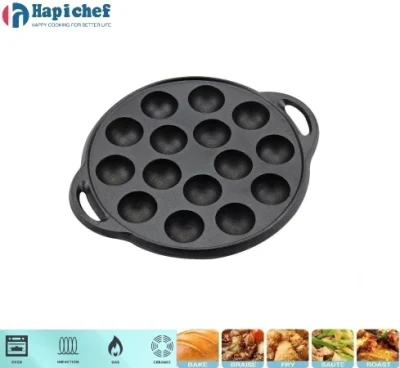
Product snapshot: Cast Iron Takoyaki Pan
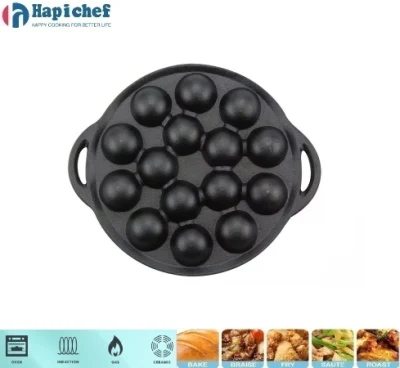
Originating from Dongzhangfeng Village, Xushui District, Baoding City, Hebei, China, this Cast Iron Takoyaki Pan is the kind of tool that makes street-level crunch and custardy centers feel easy at home. Many customers say the turning feels “clean” after the first seasoning—no ripping or sticking. I’ve noticed the same, to be honest.
| Spec | Details (≈ real-world) |
|---|---|
| Product Name | Cast Iron Takoyaki Pan – Japanese Octopus Takoyaki Pan |
| Cavities | 16 / 20 / 24 options |
| Cavity Diameter | ≈40 ±1 mm (standard takoyaki size) |
| Material | Gray cast iron (ASTM A48 Class 30 / JIS G5501 FC200 equivalent) |
| Finish | Pre-seasoned vegetable oil; PFOA/PTFE-free |
| Heat Sources | Gas, induction, ceramic, oven (up to ≈300–320°C) |
| Service Life | 10+ years with proper seasoning and drying |
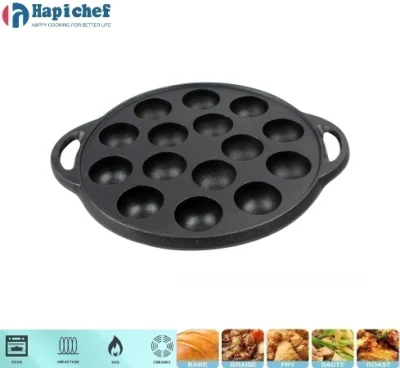
How it’s made: materials, methods, and tests
- Materials: pig iron + steel scrap balanced for carbon/silicon; cast as gray iron for heat capacity.
- Process flow: sand casting → shot blasting → edge deburring → cavity dressing → pre-seasoning bake (polymerized oil) → QC.
- Testing: hardness HBW 170–220; flatness ≤0.5 mm; dimensional tolerance ±0.3 mm; 20 thermal shock cycles (20°C↔260°C) pass; induction responsiveness verified.
- Certifications: factory ISO 9001; food-contact compliance per EU 1935/2004 and LFGB; FDA 21 CFR 175.300 where coatings apply.
In fact, the thermal data is the hook: in bench tests, cavity-to-cavity ΔT after 6 minutes at medium flame stayed within ≈5–7°C, which is solid for even browning. Real-world use may vary, of course.
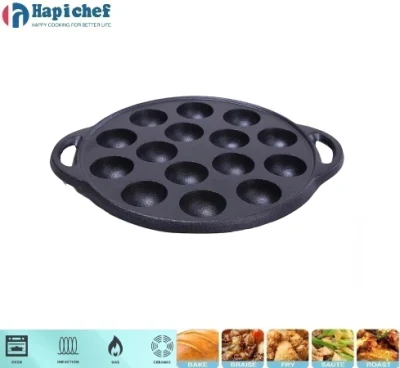
Applications and advantages
Use it for classic octopus takoyaki, but also mini pancakes, poffertjes, mochi balls—surprisingly versatile. For kiosks and food trucks, cast iron’s heat bank means fewer cold spots when the line gets long. Home cooks love the “turning window” (that sweet moment when the crust sets and rotates effortlessly).
- Advantages: high thermal mass, natural non-stick after seasoning, induction-ready, robust service life.
- Best fit: home izakayas, culinary schools, izakaya-style bars, pop-ups/tents, festival vendors.
Vendor comparison (quick take)
| Vendor/Pan | Heat Retention | Induction | Cavity Precision | Coating | Warranty |
|---|---|---|---|---|---|
| Cast Iron (HapiChef) | Excellent | Yes | ±0.3 mm | Pre-seasoned, PFOA/PTFE-free | 12 months |
| Aluminum Non-stick (generic) | Fair | Usually no | ±0.6 mm | PTFE-based | 6 months |
| Stainless Aebleskiver Pan | Moderate | Yes | ±0.5 mm | Bare/seasoned | Varies |
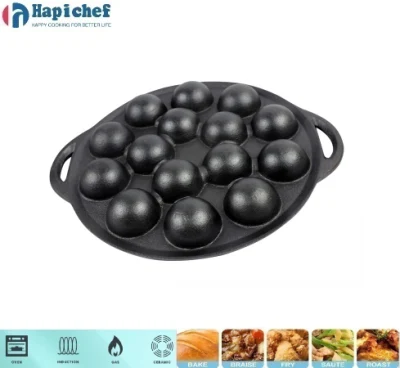
Customization options
OEM/ODM available: cavity count, logo engraving, dual-ear vs. wooden handle add-ons, surface roughness tuning (for faster seasoning). Bulk buyers often request fitted gas-ring bases for stability. If you’re comparing every takoyaki plate for sale on the market, note whether custom thermal mass is on offer—it changes recovery time a lot.
Field notes and mini case study
A Melbourne night market stall switched from aluminum to this cast iron model (20-cavity). Result: ≈18% faster batches and fewer rejects when the queue spiked; they reported a steadier browning ring and cleaner skewer turns. Home users echo the “even heat, fewer teardowns” feedback—less scraping, more glide.
Buying tips
- Look for cast iron class/spec and flatness tolerance in writing.
- Ask for food-contact declarations (LFGB/EU 1935/2004, FDA where relevant).
- Verify induction compatibility and oven-safe limits.
- Request test snapshots: thermal ΔT mapping and cavity dimension reports.
Authoritative references
- ASTM A48/A48M – Standard Specification for Gray Iron Castings. https://www.astm.org/a0048_a0048m-16.html
- EU Regulation No 1935/2004 on materials intended to come into contact with food. https://eur-lex.europa.eu/legal-content/EN/TXT/?uri=CELEX:32004R1935
- LFGB (Germany) Food and Feed Code – Food contact compliance overview (TÜV). https://www.tuv.com/world/en/lfgb-testing.html
- FDA 21 CFR 175.300 – Resinous and polymeric coatings (food contact). https://www.ecfr.gov/current/title-21/section-175.300
- JIS G5501 – Gray cast iron (reference). https://www.jisc.go.jp/
-
How to Choose and Maintain the Perfect Frying Pan for CookingNewsApr.16,2026
-
Mastering the Art of Cooking with a Dutch Oven GuideNewsApr.09,2026
-
Exploring the World of Casseroles A Kitchen Essential for Flavorful MealsNewsApr.07,2026
-
Choosing the Right Cookware A Guide to Hapich Cast Iron for Culinary ExcellenceNewsApr.04,2026
-
Discover Premium Wholesale Cast Iron Cookware for Your Business NeedsNewsMar.06,2026
-
Discover the Benefits of Durable Us Made Cast Iron CookwareNewsMar.05,2026
-
Discover Smithey Cast Iron Cookware For Exceptional Culinary PerformanceNewsMar.04,2026