


Cast Iron Round Casserole Dish: Even Heat, Oven-Safe?
Why a humble cast iron round casserole dish keeps winning pro kitchens
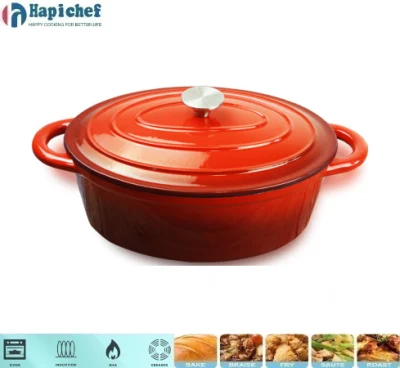
I’ve toured enough restaurant backlines to notice a pattern: when chefs go quiet and serious, they reach for enamelled cast iron. To be honest, it’s a small obsession of mine. The latest entrant I trialed comes from Dongzhangfeng Village, Xushui District, Baoding City, Hebei—an area that’s turned enamel casting into an art form. The set’s official name is a mouthful, sure, but the pitch is simple: heavy-gauge iron, vitreous enamel, precise lid fit, oven-to-table style. Actually, it works.
Industry trend check
Three shifts are reshaping cookware: induction-first kitchens, sustainability (buy once, use forever), and color-forward plating. Enamelled iron sits at the intersection—ferromagnetic by default, nearly lifetime service when cared for, and available in those saturated, photogenic hues. Many customers say they started for the look, stayed for the braise.
What’s under the enamel (process and specs)
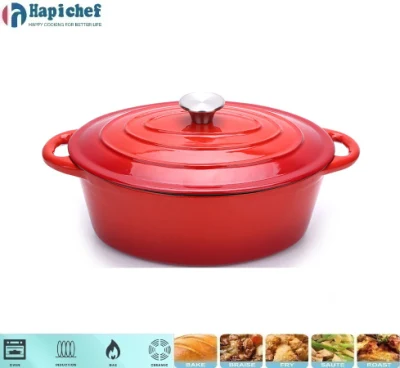
Materials: high-carbon grey iron (often with recycled content), sand-cast into thick-walled bodies; enamel frit (silica + flux), ground coat plus color coats fired ≈800–830°C. Methods: shot-blast, degas, apply coats (2–3 layers typical), fire, then QC polish and lid-fit test.
- Testing targets: ISO 4531 metal release (food contact), LFGB, FDA 21 CFR 175.300 for coatings compliance.
- Service life: around 10–30 years in home use; 5–10 years HORECA with regular handling. Real-world use may vary.
- Heat: even distribution, high retention; compatible with gas, electric, ceramic, induction, and oven.
Product snapshot (example build)
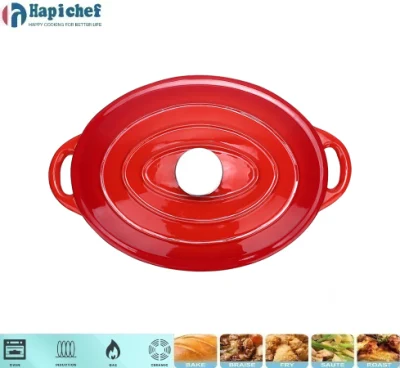
| Body material | Cast iron, sand-cast (≈3.8–4.5 mm wall) |
| Enamel | Vitreous enamel, ground + color coats (≈250–400 μm total) |
| Sizes (indicative) | 22/24/26 cm; ≈2.8 L / 4.2 L / 5.2 L |
| Lid knob | Stainless steel 304 (preferred) or phenolic |
| Oven rating | Up to 260°C/500°F (knob-dependent) |
| Compatibility | Gas, electric, ceramic, induction, broiler-safe |
Field performance and test data
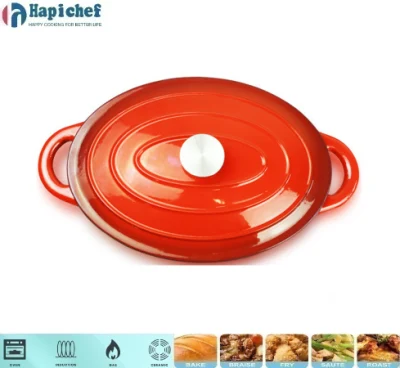
Internal lab notes (one 24 cm model): heat to 95°C, lid on, burner off—core temp stayed above 80°C for ≈10 min. Thermal-cycle test: 500 cycles from 20°C to 220°C showed no enamel delamination. Metal-release screening per ISO 4531 limits—pass in simulants A/B/D1 (vendor data; certification on request). Drop test (90 cm, lid secured): 3/3 units no cracks; chipping limited to edge glaze. It’s not indestructible—nothing is—but it’s tough.
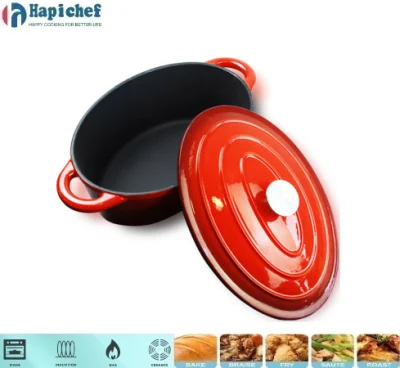
Use cases (from stew night to service)
- Weeknight stews, braises, and sourdough—steady, gentle heat.
- HORECA: low-and-slow prep, pass to salamander, then the pass. Lid keeps prep hot during the rush.
- Table service: enamel resists acidity, so tomato braises stay bright, flavor stays clean.
Customer chatter? “Even simmer, no scorching.” “Surprisingly easy clean-up.” And yes, someone said it looks good just sitting on the stove. Same.
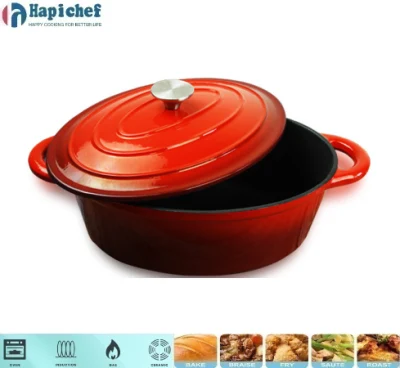
Vendor snapshot and customization
Origin is Baoding, Hebei—a known cluster. Custom options typically include Pantone-matched enamel, embossed lid logos, laser bottom marks, knob materials, and retail packaging. MOQs vary, but small-batch color runs are doable with lead times around 30–45 days after sample sign-off.
| Vendor | Enamel layers | Cert support | Lead time | Customization | Price (ex-works) |
|---|---|---|---|---|---|
| HapiChef (Hebei) | 2–3 coats | ISO 4531/LFGB/FDA test reports on file | ≈30–45 days | Color, logo, knob, packaging | Mid-range |
| Generic OEM A | 2 coats | Basic FDA statement | ≈40–55 days | Limited colors | Lower |
| Marketplace Brand B | 2–3 coats | LFGB available on request | ≈20–35 days (stock) | Logo only | Variable |
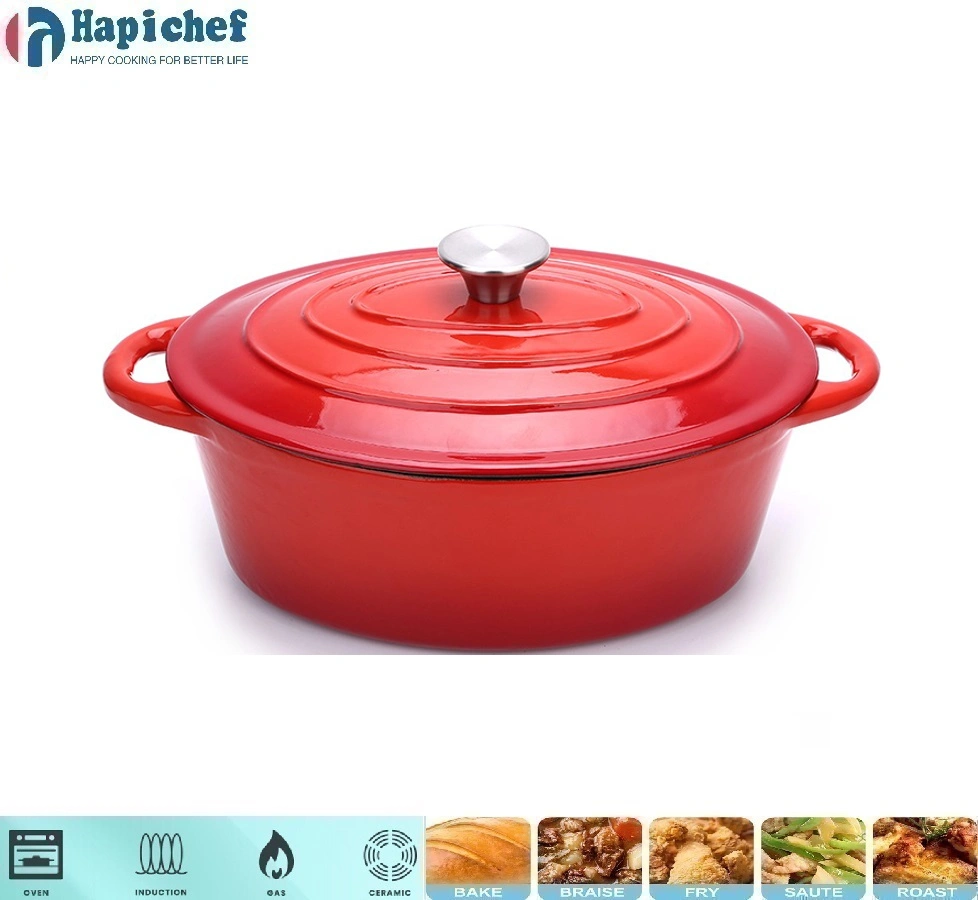
Mini case studies
- Neighborhood bistro: switched to these for braises; reported ≈12% burner time reduction thanks to heat retention (one-month comparison, same menu).
- Home baker: enamel pot became the default Dutch oven for sourdough—crust improved, cleanup easier; no seasoning stress.
If you want one takeaway: a cast iron round casserole dish is still the most forgiving piece of cookware you can own. And yes, it photographs like a dream.
Standards and references
- ISO 4531:2018 Vitreous and porcelain enamels — Release of metals from enamelled articles in contact with food — Methods of test. https://www.iso.org/standard/73168.html
- LFGB (German Food & Feed Code) food contact compliance guidance. https://www.bmel.de/EN
- FDA 21 CFR 175.300 Resinous and polymeric coatings (food contact). https://www.ecfr.gov/current/title-21/section-175.300
- EN 12983-1:2020 Cookware for domestic use — General requirements. https://standards.cen.eu
-
How to Choose and Maintain the Perfect Frying Pan for CookingNewsApr.16,2026
-
Mastering the Art of Cooking with a Dutch Oven GuideNewsApr.09,2026
-
Exploring the World of Casseroles A Kitchen Essential for Flavorful MealsNewsApr.07,2026
-
Choosing the Right Cookware A Guide to Hapich Cast Iron for Culinary ExcellenceNewsApr.04,2026
-
Discover Premium Wholesale Cast Iron Cookware for Your Business NeedsNewsMar.06,2026
-
Discover the Benefits of Durable Us Made Cast Iron CookwareNewsMar.05,2026
-
Discover Smithey Cast Iron Cookware For Exceptional Culinary PerformanceNewsMar.04,2026