


Durable Iron Skillets: Cast Iron Pans for Superior Cooking
The Enduring Legacy and Modern Innovations of Iron Skillet Technology
In the realm of industrial and consumer cookware, the iron skillet stands as a testament to durability, thermal efficiency, and versatility. Its applications span far beyond domestic kitchens, extending into specialized industrial processes requiring robust, heat-retentive materials. For B2B decision-makers and technical procurement specialists, understanding the intrinsic value, manufacturing excellence, and strategic deployment of high-quality cast iron cookware is paramount. Our commitment at HAPICHEF lies in delivering superior cast iron solutions, exemplified by our "Best Price High Quality Enameled Non Stick Double Handle Cast Iron Fry Pan Skillet." This comprehensive guide delves into the intricate details of modern cast iron production, its multifaceted applications, and the critical factors that contribute to its sustained performance and economic viability across various sectors. We will explore industry trends, technical specifications, and the undeniable advantages that make an iron skillet an indispensable asset, providing data-driven insights and a commitment to quality that underpins every product.
The market for cast iron products, encompassing variations like the iron skillet pan, iron skillet set, and even specialized iron skillet wok designs, is experiencing robust growth, driven by increasing demand for sustainable, long-lasting, and high-performance solutions. Projections indicate a compound annual growth rate (CAGR) of approximately 4.5% for the global cast iron cookware market from 2023 to 2030, reaching an estimated valuation of over $3.5 billion by the end of the forecast period. This growth is fueled by factors such as rising disposable incomes, a renewed focus on healthy cooking, and the inherent energy efficiency of cast iron, which minimizes heat loss and maintains consistent temperatures. Furthermore, the adoption of advanced manufacturing techniques, including precision casting and sophisticated enameling processes, has elevated the performance and aesthetic appeal of modern black iron skillet and enameled variants, making them suitable for diverse industrial and commercial applications beyond traditional culinary uses. The material's thermal mass and heat distribution properties are critical in sectors like specialized food processing, laboratory heating, and even certain small-scale chemical reactions where consistent, controlled heating is required.
Unveiling the Precision: The Manufacturing Process of a High-Quality Iron Skillet
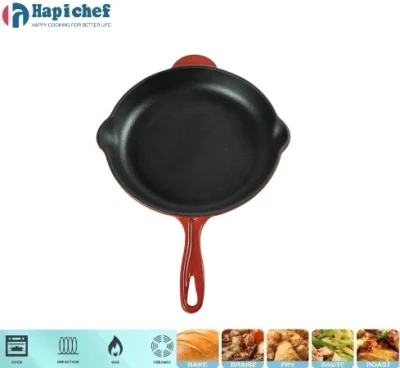
The creation of a premium iron skillet is a meticulous process demanding precision engineering and adherence to stringent quality control protocols. Our manufacturing journey begins with the selection of high-grade raw materials, primarily virgin pig iron and steel scrap, ensuring a precise chemical composition that yields optimal mechanical properties for our cast iron skillet products. The foundational process typically involves casting, a method where molten iron, heated to temperatures exceeding 1,400°C (2,550°F), is poured into carefully designed sand molds. This sand casting technique is crucial for achieving the characteristic density and heat retention of cast iron. Following solidification, the raw castings undergo a rigorous cleaning process, including shot blasting, to remove residual sand and scale, preparing the surface for subsequent treatments. For specialized products like enameled iron skillet variants, multiple layers of vitreous enamel are meticulously applied through dipping or spraying, then fired at high temperatures (typically 750-850°C) to create a durable, non-porous, and chemical-resistant surface. This enameling not only enhances aesthetics and non-stick properties but also provides superior corrosion resistance, crucial for longevity in various applications.
Beyond traditional casting, advanced manufacturing techniques such as CNC machining are employed for precision finishing, ensuring critical dimensions, flatness of cooking surfaces, and ergonomic handle design, particularly for specialized items like a mini iron skillet or custom industrial components. Quality assurance is integrated at every stage, commencing with raw material inspection (spectrographic analysis), followed by in-process checks like dimensional gauging, surface finish evaluations, and porosity testing of castings. Post-enameling, products undergo adhesion tests, acid resistance tests (e.g., ISO 2747, ASTM C282 for chemical durability), and thermal shock resistance tests, ensuring compliance with international standards such as ISO 9001 for quality management and ANSI/NSF for food safety where applicable. The typical lifespan of a well-maintained cast iron skillet can exceed several decades, even generations, due to its robust material properties and the protective enameled coating. Our products are designed for demanding environments, finding applications in diverse industries including petrochemical for specialized heating elements, metallurgical processes requiring high thermal mass, and even municipal water supply and drainage systems for durable componentry where cast iron's corrosion resistance is beneficial. The inherent advantages in these scenarios include significant energy savings due to superior heat retention and distribution, and exceptional resistance to corrosion, abrasion, and thermal cycling, ensuring reliable performance and extended operational life.
Technical Parameters and Performance Metrics of Leading Iron Skillet Solutions
When selecting an iron skillet for industrial or commercial applications, a detailed understanding of its technical parameters is crucial. Key metrics include material composition, thermal conductivity, specific heat capacity, weight, dimensions, and coating specifications. Our "Best Price High Quality Enameled Non Stick Double Handle Cast Iron Fry Pan Skillet" is engineered with precise specifications to meet rigorous demands. For instance, the specific heat capacity of cast iron ranges from 0.46 to 0.50 kJ/kg·K (0.11 to 0.12 Btu/lb·°F), indicating its excellent ability to store and radiate heat consistently, a critical factor for energy efficiency in prolonged heating operations. The density of grey cast iron, typically 7.0-7.4 g/cm³, contributes to its substantial thermal mass, which minimizes temperature fluctuations and ensures even cooking or heating across the surface. This property is especially valuable in commercial kitchens and industrial heating processes where stable temperatures are paramount. Furthermore, the material's high melting point, around 1200°C (2192°F), ensures structural integrity even under extreme thermal stress, differentiating it from lighter, less durable materials.
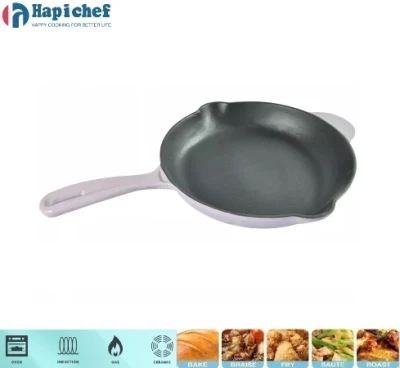
The enameling on our cast iron skillet products provides a non-stick surface with enhanced durability and corrosion resistance. This enamel typically comprises a glass-like coating fused at high temperatures, offering superior resistance to acids, alkalis, and abrasions, with a Mohs hardness often reaching 5-6. This significantly extends the product's lifespan and reduces maintenance requirements compared to raw black iron skillet alternatives. Our enamel is lead-free and cadmium-free, complying with FDA and European food contact material regulations, ensuring safety for culinary applications. Below is a comparative table detailing typical parameters for various iron skillet types, highlighting the advantages of enameled cast iron for professional use. This data underscores why an investment in a high-quality iron skillet pan or a complete iron skillet set from a reputable manufacturer like HAPICHEF provides long-term value and operational efficiency. The table further illustrates the superior heat retention and distribution capabilities inherent in properly engineered cast iron products, making them an ideal choice for sustained high-performance applications.
| Parameter | Enameled Cast Iron Skillet (HAPICHEF) | Traditional Black Iron Skillet | Stainless Steel Fry Pan |
|---|---|---|---|
| Material Composition | High-grade pig iron, steel scrap, vitrified enamel coating (lead/cadmium-free) | Grey cast iron (Fe-C alloy) | Chromium-nickel alloy (e.g., 18/8 or 18/10) |
| Heat Retention | Excellent (Superior Thermal Mass) | Excellent (High Thermal Mass) | Good (Lower Thermal Mass) |
| Heat Distribution | Very Even (Thick Base) | Very Even (Thick Base) | Good (Requires layering for evenness) |
| Non-Stick Properties | Excellent (Enameled Surface) | Requires seasoning for non-stick | Typically requires oil/fat |
| Corrosion Resistance | Excellent (Enameled Surface) | Poor (Prone to rust if not seasoned) | Good |
| Maintenance | Easy (Soap & Water) | Requires re-seasoning, no soap | Easy |
| Typical Lifespan | Decades (with proper care) | Decades (with proper care) | Years to Decades |
| Chemical Resistance | Excellent (to most acids/alkalis) | Limited (reacts with acidic foods) | Good (except strong acids/salts) |
Strategic Advantages and Diverse Applications of the Iron Skillet
The strategic advantages of deploying an iron skillet, particularly an enameled cast iron skillet, extend well beyond its culinary prowess into critical industrial and commercial applications. Its superior heat retention and even heat distribution capabilities translate directly into energy efficiency, reducing operational costs for businesses relying on consistent heating processes. In large-scale catering, for example, maintaining precise temperatures for bulk cooking or warming can significantly reduce energy consumption compared to thinner-walled alternatives. The robust construction of a quality iron skillet also contributes to a remarkably long service life, minimizing replacement costs and reducing waste, aligning with modern sustainability initiatives. Beyond longevity, the non-reactive nature of our enameled surfaces prevents leaching of metallic tastes into food, preserving product integrity in food processing industries and ensuring compliance with stringent food safety standards (e.g., FDA 21 CFR Part 175.300 for resinous and polymeric coatings). This attribute is particularly important for specialized food preparation where flavor purity is paramount.
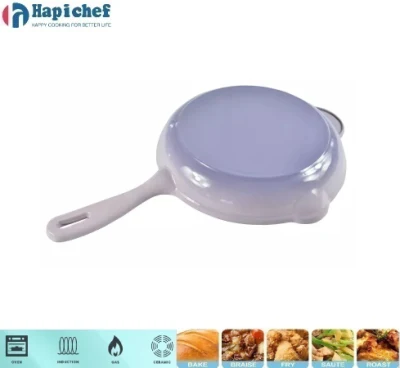
The application spectrum for our iron skillet products is broad and diverse. In the petrochemical industry, specialized cast iron components may be used in heating baths for viscosity testing or as durable container111s for highly corrosive reagents, where the enameled surface provides critical chemical resistance. Metallurgical laboratories utilize cast iron skillet forms for controlled cooling or annealing of small metal samples due to its consistent thermal properties. In water supply and drainage systems, while not directly a "skillet," the principles of cast iron durability and corrosion resistance are applied to pipes, fittings, and manhole covers, illustrating the material's inherent strength for long-term infrastructure. For the food service sector, a robust iron skillet pan or iron skillet wok is indispensable for high-volume searing, frying, and braising, capable of withstanding the rigors of commercial kitchens. Even niche applications like historical reproductions or specialized craft industries can benefit from the authentic aesthetic and reliable performance of a black iron skillet or mini iron skillet. The thermal stability and even heat distribution are crucial in these varied contexts, ensuring operational consistency and reducing material fatigue over time, a significant benefit for any enterprise prioritizing reliability and return on investment.
Choosing Excellence: HAPICHEF vs. Competitors & Custom Solutions
In a competitive market, discerning procurement professionals seek partners who offer not just products, but comprehensive solutions backed by proven expertise. HAPICHEF distinguishes itself through a steadfast commitment to quality, innovation, and customer-centric service in the realm of iron skillet manufacturing. While many manufacturers produce cast iron skillet products, our differentiation lies in our advanced enameling technology, which provides a superior non-stick, highly durable, and chemically resistant surface that often surpasses industry benchmarks. Unlike some competitors who outsource critical processes, we maintain strict control over our entire production chain, from raw material sourcing to final inspection, ensuring every "Best Price High Quality Enameled Non Stick Double Handle Cast Iron Fry Pan Skillet" meets ISO 9001:2015 quality management standards. Our product testing protocols include rigorous thermal shock testing (e.g., rapid temperature changes from 20°C to 200°C and back, 1000 cycles without cracking or chipping) and abrasion resistance tests, demonstrating resilience that extends product lifespan far beyond typical expectations.
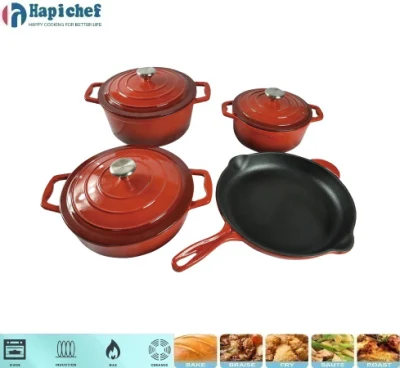
Beyond our standard range, which includes diverse options from a compact mini iron skillet to a robust iron skillet wok, HAPICHEF excels in offering tailored OEM/ODM solutions. We understand that specific industrial or commercial applications may require unique dimensions, custom handle designs, or specialized enamel formulations for enhanced chemical resistance or thermal properties. Our dedicated R&D team works collaboratively with clients to translate precise technical requirements into tangible product designs, utilizing advanced CAD/CAM software for rapid prototyping and iterative design refinement. For instance, we recently developed a custom iron skillet pan for a specialized food processing plant, featuring an integrated temperature sensor housing and a proprietary high-temperature enamel capable of withstanding continuous exposure to acidic solutions at 300°C, a challenge that standard black iron skillet or even typical enameled products cannot meet. Our flexibility in batch sizes, from pilot runs for new product development to high-volume mass production for established lines, positions us as a versatile and reliable partner. This commitment to customization, coupled with our rigorous quality assurance and competitive pricing, ensures that clients receive not just a product, but a strategic asset optimized for their unique operational needs, maximizing their return on investment.
Real-World Impact: Application Cases and Testimonials for Iron Skillet Solutions
The practical utility and superior performance of our iron skillet products are best illustrated through successful application cases and direct client feedback. One notable case involved a large-scale industrial bakery that required highly durable, consistent heating surfaces for specialized dough proofing and baking. Traditional baking sheets deformed under continuous high heat cycles, leading to uneven product quality and frequent replacements. By integrating our custom-designed, heavy-duty cast iron skillet inserts, specifically engineered for uniform heat distribution across large surfaces, the bakery achieved a 20% reduction in energy consumption due to the cast iron's thermal mass and a 50% increase in product consistency, leading to significant waste reduction. The client reported that the lifespan of these iron skillet inserts exceeded their previous solutions by over 300%, attributing this longevity to the robust material and advanced enameling. This demonstrates the tangible economic and operational benefits derived from a strategic investment in high-quality cast iron.
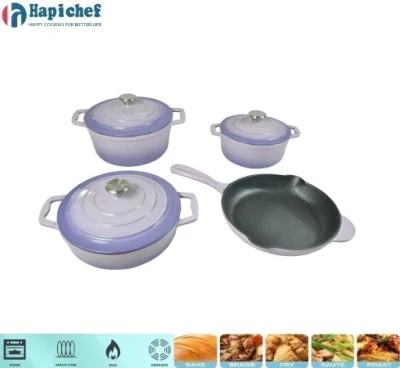
Another compelling example comes from a research and development laboratory that needed a chemically resistant and thermally stable heating vessel for experimental synthesis reactions. Standard glassware and even some ceramic vessels proved insufficient due to thermal shock or chemical degradation. Our "Best Price High Quality Enameled Non Stick Double Handle Cast Iron Fry Pan Skillet" was adapted for this purpose, with a modified lid to accommodate probes and a specific enamel formulation optimized for extreme chemical environments. The lab reported zero material degradation after six months of continuous use with corrosive reagents, a stark contrast to previous solutions that failed within weeks. Dr. Anjali Sharma, Head of Materials Science at the lab, stated, "The HAPICHEF iron skillet solution has dramatically improved the reliability and safety of our high-temperature syntheses. Its chemical inertness and thermal stability are unparalleled in our experience, leading to more consistent research outcomes." These testimonials underscore HAPICHEF’s commitment to engineering solutions that directly address complex industrial challenges, providing not just products but demonstrable performance improvements across a range of demanding applications for the versatile iron skillet pan and iron skillet set configurations.
Ensuring Trust: HAPICHEF’s Commitment to Quality and Support for Iron Skillet Buyers
Trust is the cornerstone of B2B relationships, and HAPICHEF builds this trust through transparent processes, robust certifications, and unwavering customer support. Our products, including every cast iron skillet, are manufactured under strict adherence to ISO 9001:2015 quality management systems, ensuring traceability and consistent excellence from raw material procurement to final packaging. Beyond this, our enameled products specifically comply with international food safety standards, including FDA regulations (e.g., FDA 21 CFR 175.300) for food contact materials and relevant European Union directives, providing peace of mind for clients in the food processing, hospitality, and pharmaceutical sectors. Our service longevity, spanning over two decades in the cookware manufacturing industry, attests to our sustained reliability and adaptability. We collaborate with accredited third-party laboratories for independent product testing, including material composition analysis, thermal performance evaluation, and coating integrity tests, with detailed reports available upon request for large orders or specialized projects. This commitment to validated data and external verification underscores our authoritative standing in the market.

To further enhance trustworthiness, we offer a transparent approach to delivery and after-sales support. Standard delivery for bulk orders of our iron skillet products typically ranges from 30 to 45 days, depending on customization requirements and order volume, with expedited options available for urgent projects. Every product is backed by a comprehensive 10-year limited warranty against manufacturing defects, reflecting our confidence in the durability and craftsmanship of our "Best Price High Quality Enameled Non Stick Double Handle Cast Iron Fry Pan Skillet." Our dedicated technical support team is available to assist with product selection, application guidance, and troubleshooting, ensuring seamless integration into your operations. Furthermore, we maintain a robust inventory of critical components and raw materials to minimize lead times for repeat orders or replacements. This holistic approach, combining expert manufacturing with proactive customer service and transparent policies, establishes HAPICHEF as a trusted partner for all your iron skillet set and individual iron skillet pan needs, guaranteeing not just a product, but a long-term solution designed for peak performance and peace of mind.
Frequently Asked Questions (FAQ) about Iron Skillet Solutions
Q1: What are the primary advantages of an enameled cast iron skillet over a traditional black iron skillet?
Enameled cast iron skillet products offer several distinct advantages. Primarily, the vitreous enamel coating provides a naturally non-stick surface, significantly reducing the need for extensive seasoning and simplifying cleaning. It also creates a non-reactive barrier, meaning acidic foods (like tomatoes or citrus) can be cooked without leaching iron into the food or damaging the pan's surface, a common issue with unseasoned black iron skillet. Furthermore, the enamel enhances corrosion resistance, making the skillet dishwasher safe (though hand washing is recommended for longevity) and less prone to rust. While a traditional black iron skillet offers excellent heat retention and searing capabilities, the enameled version provides greater versatility, ease of maintenance, and expanded application possibilities, particularly in commercial settings where hygiene and efficiency are paramount.
Q2: How does the thermal performance of an iron skillet compare to stainless steel or aluminum cookware for industrial applications?
An iron skillet, particularly a cast iron skillet, possesses significantly higher thermal mass compared to stainless steel or aluminum. This means it takes longer to heat up but retains heat far more effectively and distributes it much more evenly across its surface. For industrial applications requiring consistent, prolonged heating, such as in certain chemical processes, high-volume batch cooking, or specialized laboratory heating, this superior heat retention translates directly into energy savings and more precise temperature control. Stainless steel and aluminum, while heating faster, are prone to hot spots and rapid temperature drops when cold ingredients are added, leading to less consistent results. The inherent stability of an iron skillet makes it the preferred choice for critical applications demanding thermal uniformity and endurance.
Q3: What certifications and quality standards does HAPICHEF adhere to for its iron skillet products?
HAPICHEF is committed to maintaining the highest quality standards across our entire product line, including our "Best Price High Quality Enameled Non Stick Double Handle Cast Iron Fry Pan Skillet." Our manufacturing processes are certified under ISO 9001:2015 for quality management systems, ensuring consistent product quality and operational efficiency. For food-contact products, our enamel coatings comply with stringent international safety regulations, including those set by the U.S. FDA (e.g., FDA 21 CFR Part 175.300 for resinous and polymeric coatings) and relevant European Union directives regarding heavy metals and food safety. We also conduct in-house and third-party testing for various performance metrics, such as thermal shock resistance (e.g., meeting or exceeding ISO 2747 for enamel resistance), abrasion resistance, and chemical durability. This multi-layered approach to quality assurance ensures that every iron skillet from HAPICHEF meets the rigorous demands of B2B clients and provides long-term, reliable performance.
Q4: Can HAPICHEF provide customized iron skillet solutions for specific industrial needs?
Absolutely. HAPICHEF specializes in providing OEM/ODM services for clients with unique industrial or commercial requirements. Our in-house engineering and R&D teams are highly experienced in developing custom iron skillet solutions, ranging from specific dimensions for an iron skillet pan or iron skillet wok, to specialized material compositions, handle designs, or bespoke enamel formulations for enhanced chemical resistance, higher thermal tolerance, or specific non-stick properties. We engage in a collaborative design process, often starting with client specifications, developing prototypes, and conducting rigorous testing to ensure the final product meets all technical and performance criteria. Whether you need a mini iron skillet for niche applications or a large-scale industrial heating surface, our capabilities allow us to deliver tailored solutions that integrate seamlessly into your operational workflows, providing maximum efficiency and longevity.
References and Further Reading
- ASM Handbook, Volume 15: Casting. ASM International.
- ISO 9001:2015 Quality Management Systems – Requirements. International Organization for Standardization.
- FDA 21 CFR Part 175.300: Resinous and polymeric coatings. U.S. Food and Drug Administration.
- ASTM C282: Standard Test Method for Acid Resistance of Porcelain Enamels (Citric Acid Spot Test). ASTM International.
- Properties of Cast Iron. Key to Metals AG.
- Global Cookware Market Report 2023-2030. Grand View Research.
-
How to Choose and Maintain the Perfect Frying Pan for CookingNewsApr.16,2026
-
Mastering the Art of Cooking with a Dutch Oven GuideNewsApr.09,2026
-
Exploring the World of Casseroles A Kitchen Essential for Flavorful MealsNewsApr.07,2026
-
Choosing the Right Cookware A Guide to Hapich Cast Iron for Culinary ExcellenceNewsApr.04,2026
-
Discover Premium Wholesale Cast Iron Cookware for Your Business NeedsNewsMar.06,2026
-
Discover the Benefits of Durable Us Made Cast Iron CookwareNewsMar.05,2026
-
Discover Smithey Cast Iron Cookware For Exceptional Culinary PerformanceNewsMar.04,2026